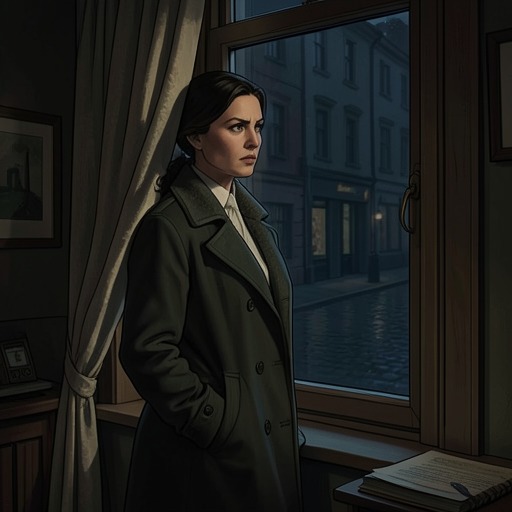
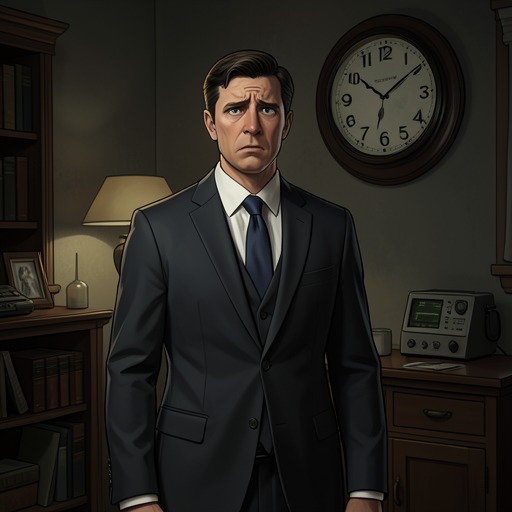
Blake’s confrontation with Jack Harkness
Panic RoomBlake’s confrontation with Jack Harkness brings her investigation into his private home and makes its central pressure personal: Harkness can answer questions, redirect them, and offer money, while Blake must decide whether to keep asking. She challenges him about the alleged theft of his partners’ money and the possibility of a panic room at Wortalleth West, then hears him turn an investigation into an opportunity to be paid off. The scene’s decisive tension lies in that offer: it promises Blake freedom from her troubles, but also gives her reason to suspect that she has found something Harkness wants kept quiet.
The Visit to Belgrave Square
Blake approaches 53 Belgrave Square through a square that seems arranged around separation. Its locked central garden is private; embassy flags claim the surrounding houses, and a bored police officer patrols outside the Turkish Embassy. Against that display of guarded territory, Harkness’s residence has no flag or brass plate to identify it. Blake sees a pillared porch, wide steps, a large wooden door with a polished handle and a dolphin knocker, and windows reflecting a cloud-barred sky. She wonders what kind of life Harkness keeps behind the glass, closed off from the world.
The house does not remain a distant façade for long. A second-floor window slides open with a squeal, and Harkness leans out, recognizes Blake, and calls to her. The recognition changes the encounter from an attempted approach into a meeting between people who already know one another. Blake smiles up at him, nervous and unsure what to say, before confirming that she is really there. The small exchange establishes a personal intimacy that sits uneasily beside the guarded square and the questions she has come to ask.
Questions and Evasions
In their conversation, Harkness recalls seeing the Earth photographed from Apollo 8 in December 1968, when he was twelve and home for Christmas. He describes the image as beautiful and fragile, and remembers realizing how vulnerable life was: the planet seemed as precarious as a bauble that could be pulled from a tree and smashed. The disclosure gives Blake a glimpse of a formative idea behind his concern for the planet. It also sharpens the contrast between that concern and the environmental damage associated with the chemicals his company has put into the biosphere over the preceding twenty years.
When Harkness asks why she came, Blake chooses the direct question rather than an excuse or a request for help. She asks whether he really stole money from his business partners. His smile does not falter; instead, he argues that money cannot be stolen if it already belongs to the person taking it. Blake immediately tests that reasoning against the court case. The exchange leaves the accusation unresolved, but makes clear that Harkness is prepared to present his own claim to the money without appearing embarrassed or rattled by the charge.
Blake next asks whether there is a panic room at Wortalleth West. Her suspicion comes from a survey arranged by Mona Harkness’s lawyer, whose investigator found a void behind the master-bedroom closet extending downstairs. Harkness responds by asking what made her think such a room might exist; the conversation supplied here does not establish whether one does. Blake also raises Coleman, the renewables salesman, and Wynsum Fry, who believes Harkness murdered her brother. Harkness calls Wynsum a witch and says he would almost have been disappointed if Blake had not mentioned her. That reply acknowledges the accusation while avoiding an answer to it.
The Proposed Settlement
Harkness then offers Blake a route to money through Ingrid Denner, who is in London for a crisis-management operation. Harkness explains that the board of Harkness Pharmaceuticals hired a New York crisis-management firm to limit damage to the company arising from his difficulties with the U.S. Justice authorities. The board made that decision in his absence. Ingrid’s work includes preventing embarrassing or compromising information from reaching the press, commonly by offering substantial cash in exchange for a signed nondisclosure agreement.
Harkness suggests that Blake may have encountered revealing documents while living at Wortalleth West and says he can warn Ingrid that she might have information worth containing. He advises her not to settle for less than fifty thousand pounds, presenting the payment as a way to travel and leave her current life behind. He stresses that the offer has no strings, traps, or small print, and that Blake can accept or decline it. When Blake compares the prospect of disappearing with Jane Glasson, Harkness says he did not mean that disappearance literally. His reassurances make the offer sound voluntary, but its connection to potentially compromising documents gives Blake a reason to wonder what Harkness is trying to prevent her from doing.
The Unresolved Choice
Blake does not leave the encounter with a simple refusal or acceptance. She recognizes that the money could take her a long way from everything and that the prospect is tempting, particularly because Harkness appears able to arrange the payment with ease. Yet the offer changes the meaning of the questions she has asked: if a settlement is being offered to silence possible disclosures, perhaps she is closer to the truth than Harkness wants her to be. His generosity thus becomes evidence to weigh, not proof of innocence or guilt.
Afterward, Blake walks around Wellington Arch and the war memorials at Hyde Park Corner, considering the competing pressures. Don Challenor wants her to stop looking for the truth; Harkness is willing to reward her for doing so. The Dorchester Hotel, where Ingrid is staying, is only a short walk away. Blake admits that she cannot ignore the offer or pretend she was not drawn to the future it dangled before her. The scene ends with the investigation still open and the choice still active: money could buy distance and freedom, but pursuing the questions may reveal why that freedom has been offered.
Narrative Significance
The scene repeatedly sets openness against concealment. Harkness appears welcoming, invites Blake to ask what she likes, and insists that the settlement contains no trap; at the same time, the alleged financial wrongdoing, the suspected hidden space, the unresolved accusation from Wynsum, and the proposed nondisclosure agreement leave important matters unanswered. Even the house participates in this tension: its polished entrance and reflective windows offer a composed public face, while Blake wonders about the private life behind them.
The confrontation also makes Blake’s investigation a question of agency rather than simply access to information. Harkness does not have to silence her by force; he offers her the means to go elsewhere, and she can see the appeal. By ending on her temptation and suspicion together, the encounter keeps the bargain unsettled and makes the next step consequential. The offer may provide an exit, but accepting it would mean acting before she knows what Harkness hopes to keep out of view.